::::::
Thousand Miles˙Talks About Music
Topic
Echoes of the Borderline: Ukrainian Women Composers and Wartime Resilience (October 17, 2026)
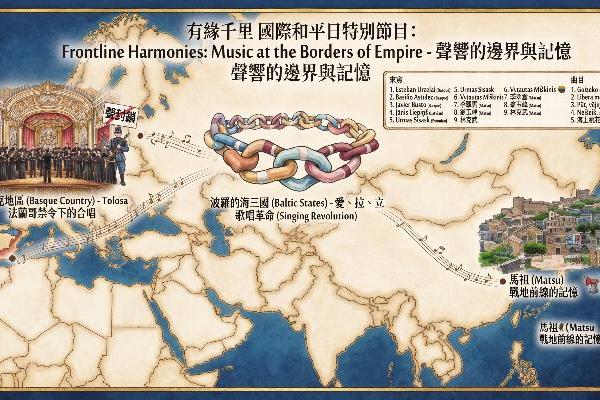
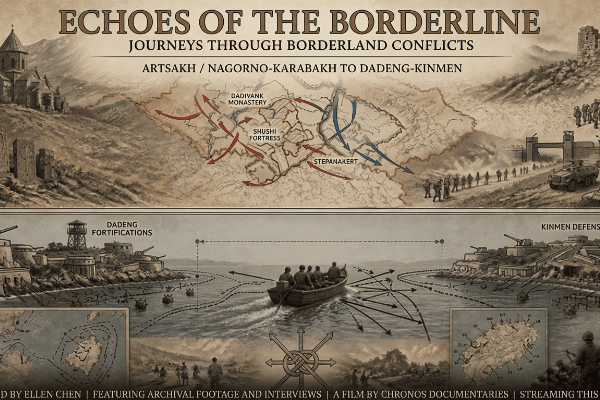
Throughout 2026, Thousand Miles Talks About Music has curated a year-long theme, "The Borders of Sound: The Music of Peace," under the production motto "Hands United in Peace." On the third week of every month, the all-English series Echoes of the Borderline travels from Taiwan's frontline islands of Kinmen, Matsu, and Penghu to regions shaped by conflict, including Ukraine, the South Caucasus, Gaza, Southeast Asia, the Basque Country, and the Baltic states. It explores the resonance between island resilience and the global search for peace.
This episode follows the United Nations' International Day of Non-Violence on October 2 and asks the question that day raises: what does resistance look like when it refuses to pick up a weapon? Eleven Ukrainian women composers answer with music.
Content
Echoes of the Borderline: Ukrainian Women Composers and Wartime Resilience (October 17, 2026)
Throughout 2026, Thousand Miles Talks About Music has curated a year-long theme, "The Borders of Sound: The Music of Peace," under the production motto "Hands United in Peace." On the third week of every month, the all-English series Echoes of the Borderline travels from Taiwan's frontline islands of Kinmen, Matsu, and Penghu to regions shaped by conflict, including Ukraine, the South Caucasus, Gaza, Southeast Asia, the Basque Country, and the Baltic states. It explores the resonance between island resilience and the global search for peace.
This episode follows the United Nations' International Day of Non-Violence on October 2 and asks the question that day raises: what does resistance look like when it refuses to pick up a weapon? Eleven Ukrainian women composers answer with music.
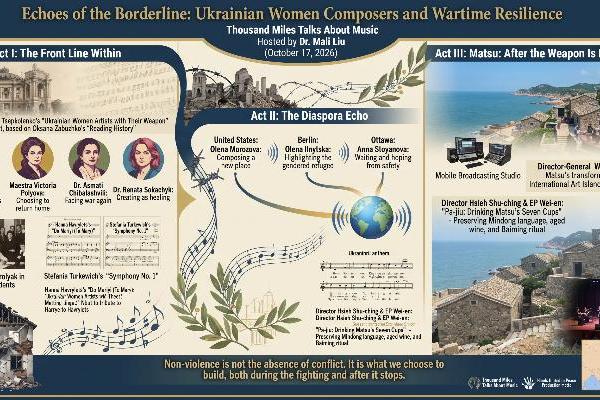
Act I, The Front Line Within, begins in Odessa. When the full-scale invasion began, veteran composer Karmella Tsepkolenko turned her response into a movement, Ukrainian Women Artists with Their Weapon. She set Oksana Zabuzhko's 2006 text Reading History, which reads like a premonition of 2014 and 2022, and invited fellow women composers to write works based on Ukrainian women poets. The project has since been performed in Germany, Estonia, Moldova, and Ukraine. In Kyiv, four composers face the same war in four different ways. Dr. Alla Zagaykevych reflects on what art is worth once a war has started. Maestra Victoria Polyova spent two safe years in Switzerland but chose to return home. Dr. Asmati Chibalashvili, who first lived through war as a child in Georgia, is facing it again. Dr. Renata Sokachyk keeps creating because creating is how she heals. In Lviv, Prof. Bohdana Frolyak describes the shock of the invasion: everything she had worked on suddenly seemed meaningless. She then found a renewed purpose in teaching her students and in speaking for Ukraine through her music. The act also features Hanna Havrylets's string work Do Mariyi (To Mary); Havrylets died in Kyiv just days after the war began. It also features the Symphony No. 1 by Stefania Turkewich, recognized as Ukraine's first woman composer.
Act II, The Diaspora Echo, follows three composers carrying the war from abroad. In the United States, Olena Morozova keeps composing and slowly builds a new place to stand. In Berlin, Olena Ilnytska points out a reality the numbers rarely show: women could leave Ukraine, but most men could not. In Ottawa, Anna Stoyanova misses home while knowing her children are safe, and she waits, like everyone else, for the war to end. The act closes with Ukraine's national anthem.
Act III, Matsu: After the Weapon Is Laid Down, answers the question from the other side: what do you build once the fighting stops?







LIVE