
::::::
Thousand Miles˙Talks About Music
Topic
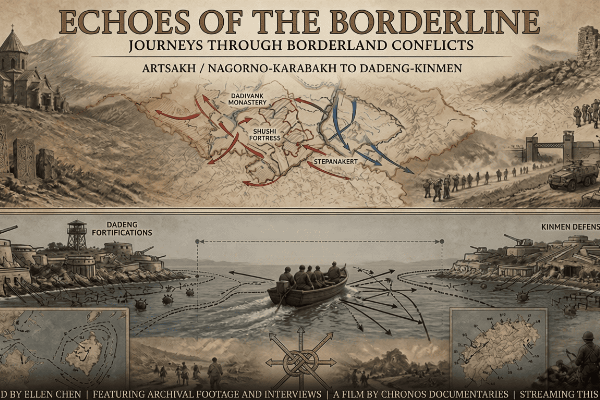
20260815 Echoes of the Borderline: The Non-Existent Once Upon a Time, Artsakh or Nagorno-Karabakh? & The Wartime Years of Dadeng Island and Kinmen in 1949: "A Three-Kilometer Boat Ride That Took Fifty Years"
Content
Every journey woven by fate has a brave story behind it. Even if the seas run dry and the rocks crumble, we will eventually hear the voice of peace. In 2026, under the production theme "Hands united in peace," we are curating a year-long peace music series titled "Echoes of the Borderline: The Music of Peace."
On the third week of every month, broadcast entirely in English, we invite you to travel from the shores of Kinmen, Matsu, and Penghu to the frontlines of global conflict in places like Ukraine, South Caucasus, Gaza, Southeast Asia, and the Basque Country, engaging in a dialogue about "borders and peace." This is not only to ensure our stories are heard, but also to build a shared bridge of understanding with people worldwide who are currently experiencing conflict or striving to rebuild peace.
This episode leads listeners across Taiwan's Kinmen and the South Caucasus region, embarking on a profound cross-national dialogue exploring war, borders, diaspora, and human resilience. Divided into three main parts and featuring ten special guests—ranging from Armenia's vanished land of "Artsakh" to Azerbaijan's alternative narrative, and back to the wartime years of Kinmen in 1949—the episode forms a powerful cross-cultural intertextuality. Details are as follows:
Part 1: The Shattered Memories of Artsakh and the Non-Existent Once Upon a Time: Testimonies of Six Armenian Artists
There Was, There Was Not is a 2024 documentary directed by Armenian filmmaker Ms. Emily Mkrtichia
Part 2: Shifting Focus to the Opposite Side of Conflict: The Narrative Perspectives of Two Azerbaijani Composers
Through the alternative perspectives of two Azerbaijani composers, Dr. İlaha Qismət and Maestro Elmir Mirzoev, the program embodies a polyphonic viewpoint, conveying the universal desire that war has no absolute victors and that mutual understanding and lasting peace can only be sought through music.
Dr. İlaha discusses the patriotic sentiment and the healing power of music in a country affected by war for years. Maestro Elmir, through his work Die Flucht aus der Zeit (Escape from Time), transforms the historical fragmentation and artistic crisis of a regionally deadlocked area into a profound reflection on time and conflict.
Part 3: Special Segment "Bridging Civilizations Through Time" - Kinmen: The Wartime Years of Dadeng Island and Kinmen
In the third movement, "Bridging Civilizations Through Time," we employ a "mobile broadcast studio" format for on-site interviews in Kinmen. We shift the focus back to the Cold War frontline of Kinmen in 1949, creating a striking cross-cultural intertextuality with the "in-between" predicament of the Caucasus.
1. Edvard Bagdasaryan: Nocturne (Arrangement for Cello and Piano by Narek Hakhnazaryan) 2. Vache Sharafyan: Violin & Duduk 3. Elmir Mirzoev Die Flucht aus der Zeit 4. 盧亮輝: 愛戀金城 5. 蘇文慶: 風獅爺傳奇









LIVE